

Do you know why they’re called Right Whales?
The name “Right Whale” means just that. In the mid-1800s, during the height of commercial whaling, these majestic creatures were considered the “right” whale to hunt. Why? Because they were easy to catch and incredibly valuable.
Right Whales had large deposits of fat, or blubber, which made them more buoyant than other whales. As a result, they floated to the surface after being killed, making them easier to retrieve—a significant advantage when whales were hunted from small boats using harpoons. In addition to their blubber, which was processed into whale oil, Right Whales are baleen whales. This means they have a comb-like structure made of keratin in their mouths that allows them to filter small organisms such as krill and plankton from the water. Baleen was highly sought after for its strength and flexibility and was commonly used to make items such as corsets, fishing rods, umbrellas, and shoehorns.
Although commercial whaling has long been outlawed, human activity continues to pose a significant threat to Right Whales today. One of the most pressing concerns is ship strikes. Since 2017, 142 Right Whales have been injured or killed by large vessel strikes—a significant number when you consider that only 384 known North Atlantic Right Whales remain. These strikes not only endanger whales but also pose risks to vessels themselves. As a result, protecting these animals has become a priority for both government agencies and conservationists.
The Lighthouse as an Aid to Navigation
How does the St. Augustine Lighthouse fit into all of this? The St. Augustine Lighthouse has long served as a crucial aid to navigation, helping mariners safely navigate the waters off Florida’s coast. However, as technology has advanced, so too has the role of the Lighthouse and the methods by which it assists passing ships. A prime example of this evolution is a piece of equipment installed at the top of the Lighthouse last year called the Stationkeeper.
The Stationkeeper is a system that works in tandem with the Automatic Identification System (AIS), which is used to track vessels in U.S. federal and international waters. It can transmit important information to mariners, including seasonal speed regulations, vessel locations, and real-time advisories about whale sightings. By keeping mariners informed and allowing them to adjust their routes, the system helps reduce the risk of ship strikes.
While the Lighthouse continues to serve as a visual beacon for vessels navigating the coastline, the Stationkeeper adds an additional layer of real-time, digital monitoring. It helps ensure that ships passing through sensitive areas—such as the seasonal habitat of the North Atlantic Right Whale—are following speed restrictions and are aware of the whales that use Florida’s East Coast as their nursery and home.
Visit the Lighthouse
Right Whales can be spotted off the coast of St. Augustine from November through April during calving season. Climb the Lighthouse and see if you can spot a mother and her calf offshore. Visit the Lens Room at the top of the Lighthouse to learn more about this incredible technology, touch a piece of baleen on display in one of our exhibits, and discover how early Lighthouse Keepers once used whale oil.
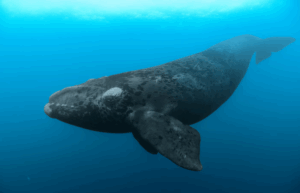 Photo Left: a North Atlantic Right Whale
 Photo Left: Look for the Stationkeeper box on your next visit to the Lighthouse