

From time to time, artifacts appear on the grounds of the St. Augustine Lighthouse & Maritime Museum. Recently, several items emerged from the dunes located behind the Lighthouse tower, including a component of a hand pump and a piece of dishware. Our conservation team immediately began working to determine the time period from which these artifacts originated. The items were likely used on site by Lighthouse keepers and their families.
Hand Pump
Some people may remember using a hand pump that drew water from an underground well. The item uncovered is a component of a hand pump that a keeper or a keeper’s family member would have used to draw water for household needs.
From this piece, we were able to identify the manufacturer as Rumsey & Co. of Seneca Falls, New York. The company was well known for producing manual well pumps. Wells were common in Florida, where groundwater is often located just below the surface. Rumsey & Co. operated from 1864 to 1942, indicating that the pump from which this part came was manufactured during that period.
Lettering around the rim of the piece reads “FIG 99 ½ No. 3,” indicating that this was the third model of this particular hand pump. This suggests it was likely manufactured closer to 1942 than to 1864.
Hand pumps were typically found outdoors, or occasionally inside kitchens, for cooking and other household uses. Due to its large size, this pump was most likely installed outdoors, as indoor hand pumps were generally smaller.
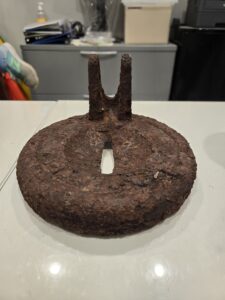
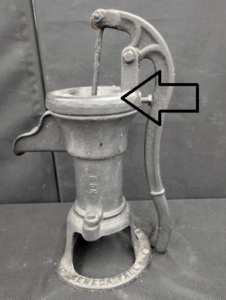
Photos Above: Left: the actual piece of a hand pump found on site prior to conservation; Right: a photo of a restored Rumsey & Co. hand pump with an arrow showing the piece that was discovered on site.
Dishware
Dishware is a commonly found artifact in the various trash pits located on the Lighthouse grounds. Keepers often discarded a wide range of items in these pits, including damaged household goods, broken dishes, and worn or unusable tools. The item recently discovered was manufactured by Vernon Kilns and features the Mayflower pattern, which was produced between 1942 and 1958.
Vernon Kilns was located in Vernon, California, and operated from 1931 to 1958. The company originally began as Poxton China in 1912 before being purchased by Faye G. Bennison in 1931 and relocated to Vernon, California, just outside of Los Angeles.
Dishes such as those in the Vernon Kilns Mayflower pattern were considered affordable and were likely used for everyday purposes, unlike more expensive china or porcelain. Given a lighthouse keeper’s salary, families would have favored practical, lower-cost dishware over luxury items. Because the plate was broken and discarded rather than repaired, it further suggests that the item was inexpensive and easily replaceable.
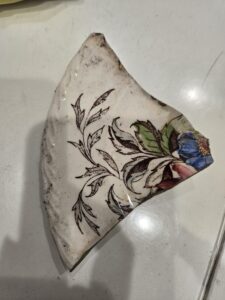
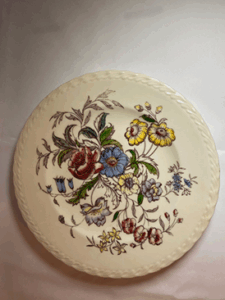
Photos Above: Left: the actual piece of dishware found on-site; Right: an image of a Vernon Kilns Mayflower plate today.