

Following the recent swells and storm surges cause by Hurricane Erin, two large ship timbers were discovered washed up on Crescent Beach. The timbers were found by the St. Johns County Beach Services, who quickly reported the find to LAMP (St. Augustine Lighthouse Archaeological Maritime Program), the research arm of the St. Augustine Lighthouse & Maritime Museum.
At this stage, the type of wood had not been identified, but samples have been collected and will be sent to Dr. Lee Newsom, a specialist in wood identification. The timbers can originate from a shipwreck dating between the 1600s and the 1800s. Though Archaeological Director Chuck Meide expertise suspects that the remains are from the 1800s. Statistically most wrecks are from the 1800’s, in fact, approximately 73% of all shipwreck finds in Florida date to the 19th century. There was significantly more maritime traffic during the 1800s and as a result more wrecks.
 Photo Left: the LAMP team stands by one of the timbers located on Crescent Beach.
One of the timbers appears to be a stern knee, a key structural component located at the rear (stern) of a ship. This identification is preliminary and based on the timber’s distinctive shape and protruding wood piece the remnants of hull planking on its outer surface. Further analysis will be needed to confirm this suspicion. Of the two timbers discovered, the knee has been thoroughly recorded and reburied to ensure its preservation, while the other has been thoroughly recorded and reburied to ensure its preservation.


Photos Above: one of the timbers shows the effects of deterioration in the air and removal from the water. Pouring water on the artifact can help keep it from increasing deterioration.
As part of the documentation process, the team used a combination of traditional and modern methods. They recorded the timber with field sketches and precise measurements, but also utilized 3D photogrammetry. Photogrammetry is a cutting-edge method that involves capturing thousands of high-resolution photos and digitally stitching them into a detailed 3D model. These models allow researchers to examine and even measure artifacts remotely with impressive accuracy, helping preserve crucial information even if the physical artifact is not present.
Once this documentation was completed the St Johns County Beach Services and the LAMP staff and volunteers quickly buried this impressive piece of timber. Why not recover both timbers, you might ask? While it would be ideal to bring every found artifact to the lab it is simply not possible as conservation of waterlogged wood is both extremely expensive and time-consuming. Exposing waterlogged wood to air causes rapid deterioration. In just three days, parts of the timber’s surface, originally preserved well enough to show the original adze marks from the ship builders, had already begun to crack and degrade.

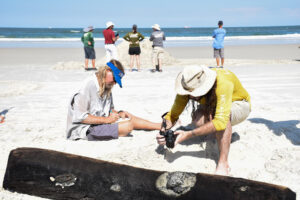
Photo Above Left: Chuck Meide and a volunteer examine the artifact; Photo Above Right: Chuck Meide and Chris McCarron document the artifact.
 Photo Left: The team directs the Bobcat to pick up the knee to move it into a hole.
 Photo Left: The Bobcat buries the timber knee for future study.
Waterlogged wood retains its shape because water replaced the cellulose lost as the cell wall breaks down. Once exposed, the absence of structural support causes the wood to shrink, warp, or crumble. Professional conservation replaces water with a bulking agent, commonly polyethylene glycol, but this process can take up to 10 years and cost thousands of dollars even for small artifacts. As a result, reburial in deep, waterlogged sand is often the most practical and effective way to preserve these coastal beach finds for future study.
Why even bother preserving these find if it isn’t going to be brought back to the lab? “These are the last physical remains of the sailing ships that were fundamentally important to our economy and day to day life,” said Chuck Meide, Director of Archaeology at the St. Augustine Lighthouse & Maritime Museum. “We hardly have any remains from these boats today. It’s like if all the cars were wiped out and only one or two survived, you’d know they existed, but you’d miss all the diversity and detail and history. These ships were taken for granted in their time. There were thousands of them, and today, only a rare few examples remain. It’s integral to our history to study and preserve these artifacts for future generations even if we have to make hard choices about what is feasible to fully conserve today.”
What should you do if you find an Artifact?
Do not touch or move it. It is illegal to disturb archaeological sites or remove artifacts, and doing so destroy the artifact’s context and value to researchers.
If you find something that may be historically significant:
1. Contact LAMP at the St Augustine Lighthouse & Maritime Museum.
2. Report it directly to the Florida Bureau of Archaeological Research.
3. Takes pictures of it and use the GPS on your phone to record its precise location
Your call could help preserve a vital piece of history.